


Home / Medical forms / ADA dental claim
ADA dental claim form OCR, tooth by tooth
The ADA Dental Claim Form is the paper claim dentists send to dental benefit plans. Older offices still call it the J430, after its old order number; the current version is the 2024 form. We set up software that reads the patient, plan and dentist details and every line of treatment, with tooth numbers, surfaces and CDT codes.
What can be read, box by box
A job reads the parts you need. For filing and payment matching, patient, plan, procedure dates and total fee are usually enough; for data entry into a claims system, every line of the record of services.
| Section (boxes) | What it holds | Read as |
|---|---|---|
| Header (1, 2) | Type of transaction (statement of services, predetermination) and predetermination number | Tick boxPrinted text |
| Dental benefit plan (3, 3a) | Plan name and address, and the payer ID added in the 2024 version | Printed text |
| Other coverage (4 to 11a) | Whether there is other dental or medical coverage, and its policyholder and plan | Tick boxPrinted text |
| Policyholder (12 to 17) | Name, address, birth date, sex, ID, plan or group number, employer | Printed text |
| Patient (18 to 23) | Relationship to policyholder, name, address, birth date, sex, patient ID or account number | Tick boxPrinted text |
| Record of services (24 to 31) | Up to 10 lines: procedure date, area of oral cavity, tooth system, tooth numbers or letters, surfaces, CDT procedure code, diagnosis pointer, quantity, description, fee | Table |
| Missing teeth (33) | The tooth chart, with missing teeth marked | Tick box |
| Diagnosis and totals (31a, 32, 34, 34a) | Diagnosis code list qualifier and ICD-10 codes; other fees and total fee | Printed text |
| Signatures (36, 37, 53) | Patient, subscriber and treating dentist | Signature |
| Ancillary information (38 to 47) | Place of treatment, enclosures, orthodontics, prosthesis replacement, accident | Tick boxPrinted text |
| Billing dentist (48 to 52a) | Name, address, NPI, license number, tax ID, phone | Printed text |
| Treating dentist (53a to 58) | Name, NPI, license number, address, specialty code | Printed text |
What makes dental claims different
Dental claims carry more short codes per line than medical ones: a tooth number or letter, one to five surface letters, the area of the oral cavity and the CDT code, all in narrow boxes. That has two consequences:
- The record of services is read as a table, so each line keeps its tooth, surfaces, code and fee together. In SimpleIndex that table is read by AWS Textract or an AI model, which can run on your own server; FlexiCapture reads it itself.
- Lists do most of the checking. Tooth numbers 1 to 32 or letters A to T, surfaces from M, O, D, B, L, I and F, and CDT codes from your fee schedule: a value outside the list stops on screen for a person.
Several versions of the form are in use: some offices still send the 2019 or 2012 version. Each older version is set up as its own layout.
Our run on sample dental claims
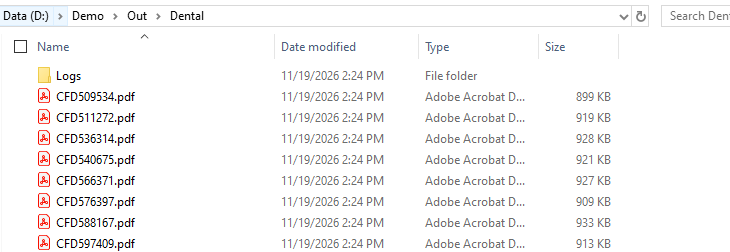
We filled in 8 made-up claims for Contoso Family Dental on the 2024 ADA form, with 1 to 5 treatment lines each, then printed and scanned them as one stack. SimpleIndex read them with AWS Textract and filed each claim as a PDF named by patient account.
The header values: payer, payer ID, patient name, birth date, patient account, date of service, total fee and billing NPI. On each service line: procedure date, area, tooth system, tooth, surface, CDT code, diagnosis pointer, quantity, description and fee.

One claim’s lines as they came out, one row per line in the index log, each also carrying the claim’s patient account and payer:
| Line | Date | Tooth | Surface | CDT code | Description | Fee |
|---|---|---|---|---|---|---|
| 1 | 10/01/2026 | D0120 | PERIODIC ORAL EVALUATION | 58.00 | ||
| 2 | 10/01/2026 | D1120 | PROPHYLAXIS – CHILD | 72.00 | ||
| 3 | 10/01/2026 | D1206 | TOPICAL FLUORIDE VARNISH | 38.00 | ||
| 4 | 10/01/2026 | 3 | O | D1351 | SEALANT – PER TOOTH | 52.00 |
| 5 | 10/01/2026 | 14 | O | D1351 | SEALANT – PER TOOTH | 52.00 |
Which product for dental claims
Both read the form on your own computers.
Smaller volume
SimpleIndex 12
Fits a dental office or billing service filing claim copies by patient and reading the header values, with the record of services read as a table when you need the lines.
Large volume
ABBYY FlexiCapture
Fits a dental benefit plan, TPA or clearinghouse with high claim volume, a verification team, and a claims system that takes 837D files.
Our SimpleIndex results for claims come from our own test batches of sample forms. Send us sample or masked forms and we’ll run them before you decide.
Questions
Is the J430 the same as the ADA Dental Claim Form?
Yes. J430 was the ADA’s order number for the form, and many offices still use the name. The current version is the 2024 ADA Dental Claim Form.
Can you test it on our claims first?
Yes. Send us made-up or masked sample claims, not real patient forms, and we’ll show you what is read and what stops for a check.
Can it read hand-written tooth numbers and codes?
It can, depending on the writing: clear digits and capitals in the boxes read best, and anything doubtful stops on screen for a person. Our run above is on typed claims; send us a few hand-filled ones and we’ll test them.
Can the data go out as 837D?
With FlexiCapture, yes. See 837 EDI exports.
Send us your dental claim volume
How many claims a month, which form versions arrive, and where the data goes. We’ll answer with the setup that fits and a free quote.
Contact usor call +1 (865) 637-8986
Please don’t send real patient forms. We’ll send you sample forms to test with.
